
India has announced significant changes to its visa framework, consolidating existing categories and introducing a clearer structure for foreign nationals travelling to India for business, employment, education, medical treatment and other purposes.
The revised framework is intended to make it easier for foreign nationals to identify the appropriate visa based on their purpose of travel. For international businesses and employers, it provides greater clarity on the visa requirements for business visits, specialised technical assignments and long term employment in India.
While the revised framework is a welcome step towards simplifying India's immigration procedures, selecting the appropriate visa will continue to depend on the purpose of travel, the nature of activities to be undertaken in India and the applicable eligibility criteria and visa conditions.
In this article, we examine the key changes and their practical implications for foreign nationals and employers planning travel or assignments to India.
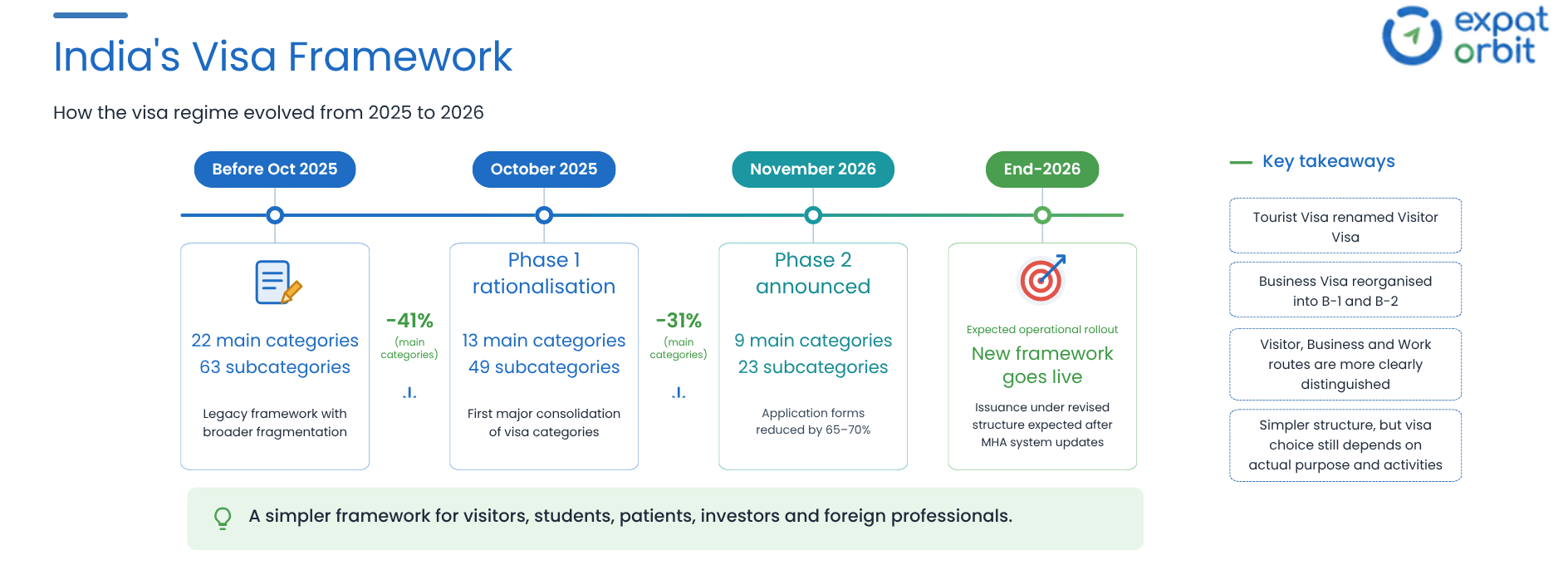
India's revised visa framework comprises nine principal categories covering business, employment, education, medical treatment, tourism and other specified purposes. The scope of each category and the relevant visa subcategories are outlined for easy reference.
Implementation Timeline: The Ministry of Home Affairs (MHA) is currently upgrading its IT systems to implement the revised visa framework, with issuance under the new structure expected to commence by the end of 2026. Until then, applicants should continue to follow the existing visa categories, eligibility requirements and application procedures.
The revised Business Visa framework introduces two subcategories, distinguishing between long term business and investment activities and short term contractual engagements.
An important change is the inclusion of the Production Investment Business Visa, previously issued under the e-B4 nomenclature, will now fall under the B-2 category.
Introduced in 2025, the Production Investment Business Visa enables foreign engineers, technical specialists and subject matter experts to undertake specified activities in India, including equipment installation and commissioning, quality checks, essential maintenance, production support, IT and ERP implementation, technical training and technology transfer.
Eligible foreign professionals can apply through the e-Visa platform, subject to the applicable eligibility and sponsorship requirements.
For further details on the scope, eligibility and application process, refer to our earlier advisory on the Production Investment Business Visa (e-B4).
For international companies with operations, projects or commercial interests in India, the restructuring of the Business Visa category is particularly relevant.
Under the revised framework, the Work Visa covers foreign nationals undertaking long term employment with Indian companies or organisations, including those engaged in specified NGO work and missionary activities.
This category is particularly relevant for foreign professionals relocating to India for managerial, technical or specialist roles. Eligibility continues to depend on the nature of employment, proposed assignment arrangements and prescribed conditions, including the revised minimum annual remuneration threshold of INR 24 lakh, where applicable.
Based on our recent experience, FRRO authorities have been closely examining compliance with the revised salary requirement, seeking additional remuneration details and supporting documentation, and in certain cases requiring in person verification during registrations and visa extensions.
For further details on the revised remuneration requirement and its implications for expatriates and employers, refer to our earlier advisory, India Employment Visa Minimum Salary Threshold Increased to INR 2.4 Million.
The existing Tourist Visa has been renamed the Visitor Visa, with its scope expanded to cover a wider range of travel purposes, including short term business meetings, medical consultations, wellness retreats and cultural activities.
The revised category comprises two subcategories:
The duration of stay permitted on each visit will continue to be governed by the applicable visa conditions, irrespective of the overall validity of the visa.
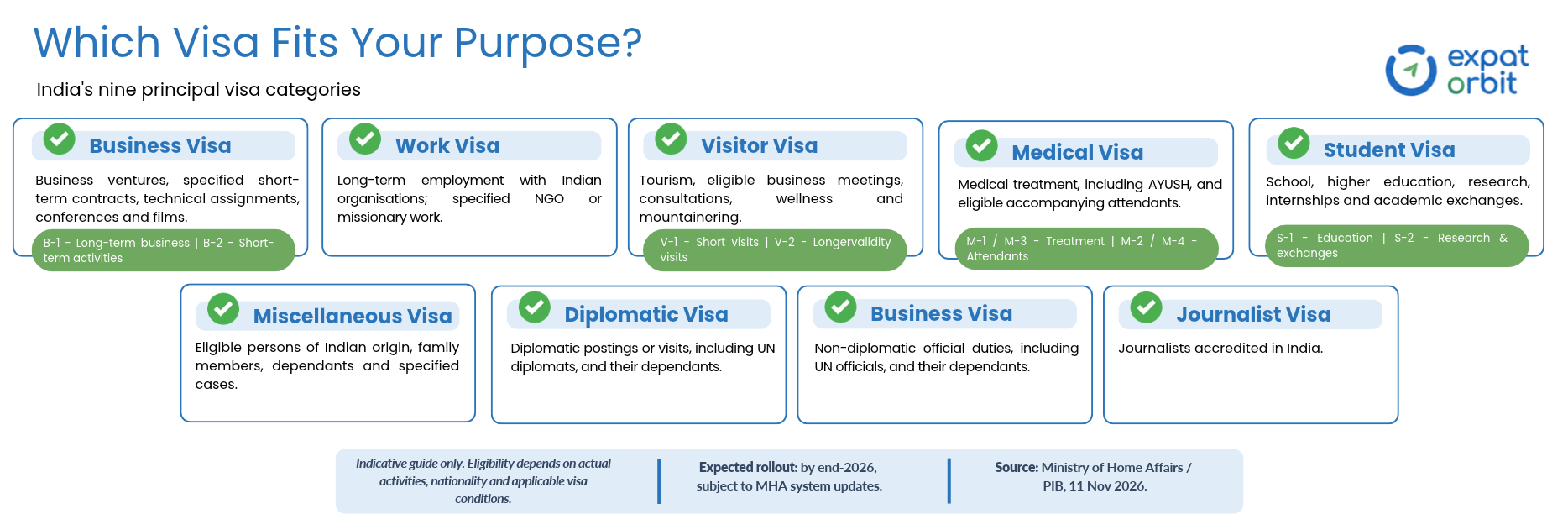
The revised visa framework brings greater clarity to the immigration requirements for foreign nationals travelling to India for business, employment and technical assignments. Several activities previously covered under broader Business or Employment Visa classifications have now been more clearly identified within the revised categories.
For foreign nationals and employers planning travel or assignments to India, the following comparison provides a practical overview of the earlier and revised visa classifications.
| Purpose of Travel or Assignment | Earlier Visa Classification | Revised Visa Classification |
|---|---|---|
| Establishing an industrial or commercial venture, including long term licence based business activities | Business Visa | Business Visa (B-1) |
| Short term contractual activities, including conferences, sporting events, cultural performances and film production | Business Visa or other applicable category | Business Visa (B-2) |
| Production related technical assignments, including equipment installation, commissioning and technology transfer | Production Investment Business Visa (e-B4) | Business Visa (B-2) |
| Long term employment with an Indian company or organisation | Employment Visa (E) | Work Visa |
| Short business meetings with clients, colleagues or business associates | Business Visa / e-Business Visa commonly used | Visitor Visa (V-1), with eligible activities also covered under V-2 |
| Short visits for recruitment, trainings or other such activities | Business Visa | Visitor Visa |
The comparison is indicative and reflects the classifications outlined in the MHA's November 2026 announcement. Actual eligibility will depend on the nature of the proposed activities and applicable visa conditions.
The changes also extend to foreign nationals travelling to India for medical treatment, education and research.
While these changes should make visa selection more straightforward, the nature of activities, employment and assignment arrangements, and applicable visa conditions will continue to determine the appropriate immigration route.
Further clarity on eligibility, documentation and application procedures is expected as the Ministry of Home Affairs completes the necessary system updates. Until the revised framework becomes operational, foreign nationals and employers should continue to follow the existing visa procedures and requirements.
Whether an overseas executive is visiting India for business meetings, a technical specialist is being deployed to an Indian project, or a foreign professional is relocating for employment, each situation requires careful consideration of the applicable immigration requirements and assignment arrangements.
Expat Orbit provides comprehensive global mobility advisory services, supporting international businesses and expatriates throughout the assignment lifecycle, from mobility policy design and assignment planning to deployment, ongoing compliance and eventual repatriation. Our expertise spans immigration, secondment structuring and documentation, expatriate taxation, payroll and social security, enabling employers to manage international assignments through a coordinated approach.
Our dedicated team of immigration specialists assists with determining the appropriate visa category, preparing and coordinating applications with the relevant Indian Embassies or Consulates, and managing immigration formalities before arrival, upon arrival and throughout the assignment. This includes FRRO registrations, visa extensions, ongoing immigration compliance and departure formalities.
For a practical understanding of India's visa framework, application procedures and immigration compliance requirements, explore **Expat Orbit's India Immigration Guidebook.**
Planning a business visit, technical deployment or employment assignment to India? **Schedule a consultation with our immigration specialists** or write to us at [email protected] to discuss your requirements.