

Over the years, global companies undertaking projects in India have faced different versions of the same challenge.
The company may be an equipment manufacturer, an engineering business, a technology provider, an EPC contractor or a specialist service company. It has secured an important project in India and now needs some of its engineers, technicians or technical specialists to work at the Indian project site.
The engineers may be coming from Japan, Taiwan, China, Singapore, Malaysia, Indonesia, South Korea, Germany, France or another location where the company has its engineering teams or group operations. Sometimes there are only two or three specialists involved. In other cases, a larger technical team needs to move.
Typically, the project has already reached a fairly advanced stage by the time mobility becomes a discussion. Contracts have been signed, equipment may have been manufactured or shipped, the Indian customer has a project schedule, and the overseas project manager has committed a mobilisation date.
Then someone asks: What visa should our engineers travel on?
That sounds like an immigration question. In reality, it is usually the beginning of a much wider discussion about how the company will put a foreign technical workforce on the ground in India and keep that workforce properly supported for the duration of the project.
If the company already has an established Indian entity with mobility, HR, payroll and finance teams, the answer may be relatively straightforward. The situation becomes more interesting when the overseas company has won the Indian project but does not have an operating entity here.
Who sponsors the employee? Who employs the individual locally if that becomes necessary? How will Indian payroll and tax work? What happens after arrival? Who manages immigration registrations, social security, tax registration, accommodation and banking? What if the project gets extended? And who closes everything when the engineer eventually returns home?
These questions are connected. Treating each of them as an independent transaction is often where an otherwise manageable assignment starts becoming difficult.
This guide looks at the complete problem from the perspective of an overseas project manager responsible for deploying foreign engineers and technicians to India.
One of the first things I would establish is the exact nature of the individual's activities in India.
This is more important than how easy a particular visa is to obtain, how long the visa is valid or what visa the engineer may have used for previous visits.
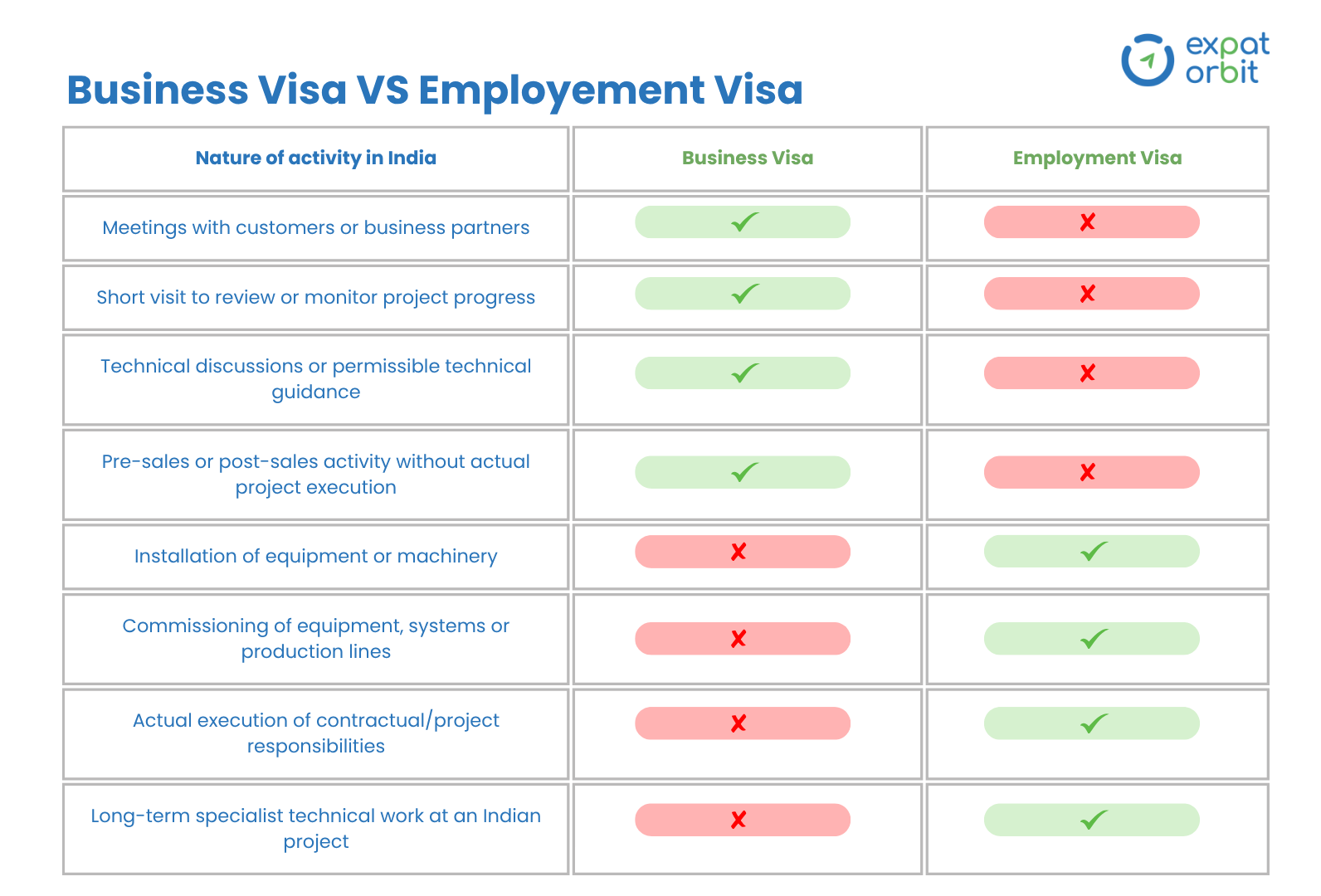
India's Business Visa framework permits certain business and technical activities. Whether it is appropriate for a particular assignment, however, depends on what the individual will actually be doing in India.
The Ministry of Home Affairs is quite direct on this point. Its published work-visa guidance states that a foreign national coming to India for execution of a project or contract is required to come on an on a Work visa or as formerly an Employment visa. The same guidance specifically identifies foreign engineers and technicians coming for installation and commissioning of equipment, machines or tools as a category eligible for an Employment Visa, subject to the applicable conditions.
This distinction matters considerably for engineering and industrial projects.
An engineer coming to India for four days to meet the customer, inspect progress and discuss a technical issue is very different from an engineer who will spend the next nine months at the plant, commissioning machinery or executing a defined part of the technical scope.
It is therefore not enough to ask, “Can the engineer obtain an e-Business Visa?”
The better question is,“Does a Business Visa appropriately cover what this engineer will actually be doing after reaching India?”
In the context of foreign engineers coming to India for project execution, Employer of Record, or EOR, is a term that has become widely used in international hiring. However, it is important to understand what problem the arrangement is actually intended to solve.
The EOR provides the local employment and compliance framework around the assignment.
Under an appropriately structured arrangement, an Indian organisation steps in as the local employer and handles the agreed employer responsibilities. Though the overseas company continues to manage the technical work for which the employee has been deployed.
An EOR arrangement is not only an execution exercise. The assignment has to be structured before it is documented, and questions continue to arise once the individual is working in India.
The structure comes first. Who employs the person and who supervises the work, how the home country and Indian arrangements sit alongside each other, how the cost is borne between the two companies and how long the deployment is expected to run. That analysis determines the employment documentation, which then has to hold up at the visa application, at the FRRO, at payroll setup and again at extension.
Our involvement at Expat Orbit therefore begins with the structure, extends to the documentation built around it and continues as an advisory relationship through the assignment rather than ending at onboarding.
This is the basic model we use at Expat Orbit. The expatriate can be onboarded into an Indian employment structure, while the overseas project company retains operational supervision of the employee's work at the project. The Indian employment platform then supports the agreed immigration, payroll and employer-compliance responsibilities around that arrangement.
For a foreign company deploying only a handful of specialists, this can be particularly useful.
There is another reason why the model can work well for project deployments. The company generally needs much more than somebody willing to sign a visa sponsorship letter. Once the individual is locally employed, there is a continuing responsibility around payroll, taxation, social security, immigration extensions, employee documentation, accommodation, cultural orientation and day-to-day expatriate support, followed eventually by departure and exit formalities.
Under an EOR, the employer obligations and compliances sit with the EOR partner rather than with the overseas company. Employment documentation, payroll, tax withholding, provident fund, visa extensions and departure compliance are handled by a party that does this routinely, under a single point of accountability in India.
 EOR Guidebook
Need to employ or deploy foreign professionals in India without setting up an entity?
Download our Guide to Employer of Record and Foreign Employee Deployment in India, covering EOR structures, visa sponsorship, payroll, taxation, social security and ongoing employer compliance.
We, equally would not recommend forcing every foreign technical deployment into an EOR structure.
If the individual's activities genuinely fall within the permitted Business Visa framework, an Employment Visa and local employment arrangement may not be necessary.
For certain short-term commissioning assignments, the newly introduced eB-4 Visa may also be relevant. This route can permit eligible foreign technicians and specialists to undertake commissioning work in India for 3 moths to 6 months, subject to the applicable requirements, including a sponsorship letter from the Indian company.
If the Indian customer is comfortable providing the appropriate Employment Visa sponsorship and the wider payroll, tax and employment issues have been dealt with in another appropriate manner, that structure should be considered on its merits.
And if the overseas company is planning a substantial permanent operation in India, expects significant local headcount and has a long-term commercial strategy here, establishing its own Indian entity may ultimately be more appropriate than continuing through an EOR.
The project, role, duration, existing employment relationship, proposed supervision model, Indian presence and willingness of the Indian customer to participate in the sponsorship arrangement should all be understood before choosing the structure.
An international assignment should generally be viewed across five stages: pre-arrival, arrival, the period during which the individual is working in India, departure, and post-departure. The support framework for such assignments should follow the employee across each of these stages, rather than treating immigration, payroll, tax, and relocation as separate and disconnected requirements.

That lifecycle matters because the project manager's requirement is not really to obtain a visa. The requirement is to have the engineer available and productive in India for the period during which the project needs that person.
All of the above stages needs to be managed by whoever is acting as the employer in India, whether that is the company's own subsidiary, the Indian customer or an EOR.
A properly planned Employment Visa assignment starts before the application itself is filed.
The role should first be understood well enough to establish why the foreign specialist is required and what the person will be doing in India. The employment or assignment documentation should be consistent with that position, and the individual's technical qualifications and experience should be properly documented.
The current Ministry of Home Affairs guidelines provide that Employment Visas are generally available to foreign nationals engaged in highly skilled or specialised professional roles. For most sectors, the applicable regulations require the applicant to receive annual remuneration has a minimum cap of USD 25,000, although certain specified categories are exempt from this requirement. The application must also be supported by documentation establishing the applicant’s proposed employment in India, educational qualifications, and relevant professional expertise.
If an individual is being deployed to India because of specialised knowledge of a particular manufacturing process, experience in commissioning specialised equipment, or familiarity with proprietary technology, the immigration documentation should clearly reflect that technical context.
This is particularly important where the role could otherwise appear generic. The objective is to present a consistent explanation of why this particular foreign professional is being deployed for the Indian assignment.
Pre-arrival planning is ultimately about ensuring that the necessary documentation, arrangements, and compliance requirements are addressed before the employee travels to India, rather than dealing with unexpected issues after arrival.
Preparing an engineer for a first assignment in India?
Our Expatriate's Guide for India is written for the individual rather than the company. It covers what to arrange before departure, the sequence of formalities in the first fourteen days, and the practical side of settling in: getting an Indian SIM at the airport, using UPI and digital payments before a bank account exists, everyday apps for food, travel and healthcare, and what to expect culturally in the first few months.
It is a useful document to send to the employee once the assignment has been confirmed. Download free guidebook
When the engineer arrives in India, there may be several formalities to complete alongside starting the project. Depending on the assignment, these can include accommodation reporting, FRRO/FRO registration, PAN, payroll onboarding, social security and opening an Indian bank account.
For Employment Visas valid for more than 180 days, current MHA guidance provides for FRRO/FRO registration within 14 days of arrival. Registration is not required for Employment Visas issued for 180 days or less.
The sequencing of these activities matters. Accommodation details can affect immigration documentation, while FRRO registration, PAN and banking may be needed for subsequent tax and payroll processes.
Our arrival framework brings these requirements together, covering FRRO, PAN, banking and accommodation rather than leaving the expatriate to coordinate each separately.
For an engineer arriving at an industrial project site, managing these formalities efficiently means less administrative distraction and more time focused on the project.
After the arrival formalities are complete, the assignment moves from a one-time immigration exercise to an ongoing employment and compliance responsibility.
Throughout the assignment, the following may need to be managed:
Visa sponsorship may solve the immediate mobilisation requirement. However, the underlying employment and compliance arrangements must continue to function accurately throughout the assignment.
Our EOR framework brings these responsibilities together rather than leaving the company to coordinate multiple vendors. For headquarters, the benefit is not simply fewer vendors or invoices.
Social security is one area that can materially affect the cost of an expatriate assignment.
Foreign nationals working in India can come within the provident fund framework applicable to International Workers. Where applicable, both the employer and employee are generally required to contribute 12% of the applicable PF wages towards the Employees' Provident Fund (EPF), subject to the rules applicable to the individual.
India also has Social Security Agreements (SSA) with a number of countries that can, subject to the relevant conditions, provide relief from Indian social-security contributions.
Want to check whether India has an SSA with your home country?
See the list of countries with Social Security Agreements signed with India and understand where an agreement may apply to your assignment.
View the SSA country list →
https://expatorbit.com/infographics/list-of-countries-having-an-ssa-signed-with-india/
India's operational agreements include countries such as Japan, Germany, France, South Korea, Taiwan, Australia and several other jurisdictions. The purpose of these agreements includes mechanisms such as detachment, which can allow an eligible employee who remains covered in the home-country system to obtain exemption from contributions in the host country for the applicable period.
The existence of an agreement should not, however, be equated automatically with exemption from Indian provident fund. Eligibility depends on the relevant agreement, the employee's existing social-security coverage, the nature of the assignment and the availability of a valid Certificate of Coverage. A locally employed individual and a traditional home-country secondee may therefore require different analysis. However, expatriates covered under an applicable SSA can withdraw their provident fund balance immediately after completing their assignment in India, subject to the applicable conditions.
Likewise, employees coming from countries without an applicable SSA can have a different cost and withdrawal position, as they may generally be able to withdraw their provident fund balance only on attaining the age of 58, subject to the applicable rules.
Therefore, the position should be worked out before the employment package is committed, because the answer can affect both employer cost and the individual's net compensation.
Need to understand the PF position for your assignment?
Our guide explains PF withdrawal for expatriates, including SSA and non-SSA cases, withdrawal conditions, tax implications and the practical steps involved.
Read the Expatriate PF Withdrawal Guide → Download Free Guidebook
There is another side to expatriate deployment that is often underestimated.
A company may be moving an exceptional engineer with specialist knowledge of a particular manufacturing process or equipment. From headquarters, the movement can look straightforward: obtain the visa, book the flight and get the engineer to the project.
For the person actually moving, the experience is very different.
He or she may be arriving in a country never visited before and simultaneously trying to arrange accommodation, understand local processes, open a bank account, organise transportation and adapt to a new workplace culture, all while being expected to deliver on a technically demanding assignment.
This is why we would not classify accommodation, commuting or cultural orientation simply as relocation benefits. For project-critical employees, they are part of the infrastructure around successful project execution.
Anyone who has worked on a complex project knows that the original assignment period is often only an estimate.
Project timelines may shift due to various factors, such as delays in equipment reaching the site, changes to the customer’s implementation sequence, extended testing requirements, or the need for the same engineer to remain in India for a subsequent phase of the project.
An assignment originally planned for nine months can easily become twelve or eighteen.
Immigration and employment documentation need to move with the project.
The current MHA guidance permits extension of Employment Visas, subject to the applicable conditions, continued employment documentation, tax compliance and other requirements. It also provides for extensions within prescribed overall limits depending on the visa category and circumstances.
The same principle applies to employment contracts, FRRO permissions, and other related compliance requirements. When an assignment is viewed as a whole, changes in the project duration may have implications across multiple workstreams and therefore need to be considered collectively rather than in isolation.
Depending on the individual's circumstances, departure may involve final payroll, a review of tax obligations, applicable tax-clearance procedures, FRRO deregistration and other immigration formalities. An Indian income-tax return may still need to be filed after the individual has left the country, and subsequent tax queries can arise when the expatriate is already back home.
Social-security balances may also need to be addressed, subject to the individual's nationality, eligibility and the applicable withdrawal rules.
Our assignment framework therefore includes departure and post-departure support such as immigration deregistration, tax-clearance assistance where applicable, final India tax filing and social-security withdrawal assistance where permitted.
Foreign technical deployments are best managed as one connected mobility and workforce requirement rather than as a series of separate services.
At Expat Orbit, the engagement can begin with understanding the assignment and assessing the appropriate deployment and visa model. Depending on the agreed structure, this can extend through employment documentation, Employment Visa sponsorship, immigration coordination and arrival in India.
Once the individual is in India, we can support the ongoing requirements around FRRO, PAN, banking, payroll, employee taxation, social security, visa extensions and expatriate support. This can also include accommodation, commuting, cultural and language orientation and day-to-day assistance where required.
Where the required specialists have not yet been identified, recruitment support can also form part of the deployment process, followed by the appropriate employment, immigration and compliance arrangements.
At the end of the project, support can continue through departure and post-departure compliance, providing a single framework around the employment, immigration and practical requirements of the assignment.
The objective is to ensure that the people delivering the project have the appropriate employment and immigration structure in place, while the administrative and compliance requirements are managed throughout the assignment.

If your company has secured a project in India and is evaluating how to deploy foreign technical personnel, it is generally better to examine the structure before visa applications and travel dates are finalised.
You do not need to prepare an elaborate brief for an initial discussion. Five pieces of information are usually enough to begin:
If the technical specialists have not yet been identified, tell us what capabilities you require and we can also discuss overseas recruitment support.
Write to us: [email protected], or Schedule a discussion
A short discussion at the planning stage can often identify issues that become considerably more difficult to resolve after the engineer has already arrived in India.
A successful deployment is ultimately about getting the engineer to India on time, with the right visa and compliance in place, and making sure the practical issues do not get in the way of the project. Once those are taken care of, the engineer can focus on the job they were sent to India to perform.
Over the years, global companies undertaking projects in India have faced different versions of the same challenge.
Want to Know More? Explore the Detailed Guide & FAQs → Click here