
Foreign Assets Information Report: What to Check Before Filing Your Income Tax Return?

India - EU Free Trade Agreement (4)

Summary

For many taxpayers with overseas accounts or investments, July is the time when they begin pulling together the information needed for foreign asset disclosure in their Indian tax return.

This is not always a simple exercise. The details may be spread across foreign bank statements, brokerage accounts, employer stock plans and old investment records. Some information may not be readily available, and the reporting itself follows a different period from the rest of the tax return. For Assessment Year 2026–27, foreign assets are generally reported with reference to the calendar year ending 31 December 2025, rather than the financial year ending 31 March 2026.

A recent development from the Central Board of Direct Taxes may make this exercise somewhat easier. Foreign financial account information received by India from other countries can now be uploaded into the taxpayer’s Annual Information Statement. The Income Tax Department has also introduced a Foreign Assets Information report, which allows taxpayers to see the information reported about their overseas accounts and investments and compare it with their own records before filing the return.

In this article, we explain what has changed, who is required to report foreign assets, how to access and use the new report, which schedules and forms may apply, and the common issues to watch out for while filing the return for Assessment Year 2026–27.

What changed?

India receives financial account information about its tax residents from more than 100 countries under the Common Reporting Standard and, in the case of the United States, under FATCA. That is not new. What is new is that taxpayers can now see this information too.

By an order dated 8 July 2026, the CBDT authorised the Director General of Income-tax (Systems) to upload information received under the Automatic Exchange of Information framework into the Annual Information Statement (AIS), within 90 days from the end of the month in which it is received. This means the foreign account information available with the department can now also be viewed by the taxpayer in the report section of the compliance portal, and can be downloaded in PDF format.

The department has described this as a step to help taxpayers rather than to investigate them. Either way, the practical effect is clear: the department already has the information, taxpayers can now see what has been reported, and any difference between that information and the tax return can be identified even before the return is filed.

Who has to report foreign assets?

This is the first question to answer, because everything else follows from it.

The test is residential status, not nationality. Schedule FA applies to individuals who qualify as Resident and Ordinarily Resident (ROR) in India for the relevant year. Non-residents and individuals who are Resident but Not Ordinarily Resident (RNOR) are not required to complete Schedule FA. Residential status must therefore be determined separately for each year, based on the individual’s stay in India and residence history.

In practice, the reporting requirement commonly arises for the following taxpayers:

  • Foreign nationals on assignment in India. Foreign nationals generally arrive in India as non-residents, spend a period as Resident but Not Ordinarily Resident (RNOR), and then become ROR, usually from the third year onwards. From that point, their overseas bank accounts, pension and retirement holdings, employer shares or stock awards, investments and property may become reportable in India.
  • Indians returning from a posting abroad. Returning Indians mostly become ROR, at which point the accounts and investments built up while they were overseas become reportable. High-net-worth individuals are also subject to foreign asset reporting based on their residential status.
  • Indians living in India who hold overseas assets. This may include shares or ESOPs in a foreign parent company, investments made through an overseas brokerage account, property outside India, or a bank account retained after an earlier overseas assignment.

There is also a limited relaxation for foreign citizens who are in India on a business, employment or student visa. A foreign asset acquired during a year in which the individual was non-resident in India is not required to be reported if no income is derived from that asset during the relevant year. If the asset generates interest, dividends, rent or any other income during the year, foreign asset reporting becomes applicable. This relaxation is specific to foreign citizens and does not extend to an Indian citizen returning from an overseas posting.

How to access your report from the Compliance Portal

Follow the steps given below to access your FAI Report -
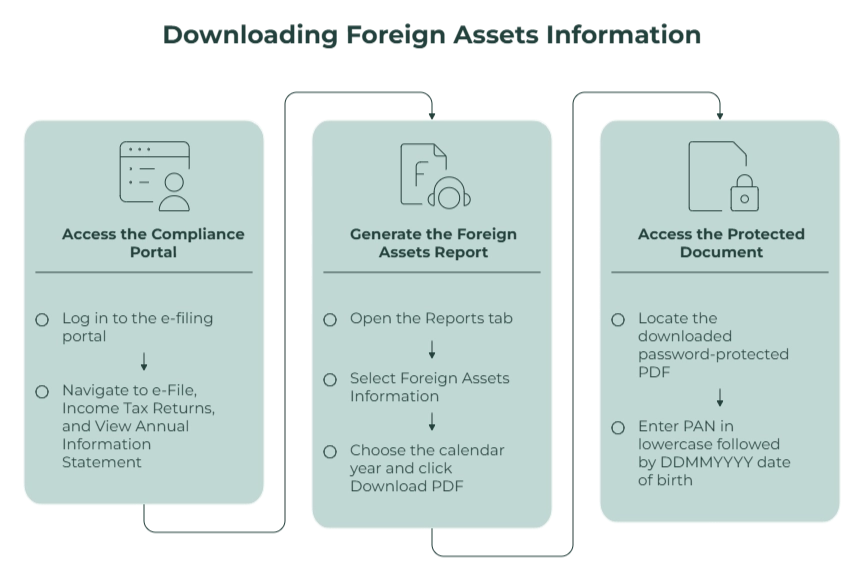
 

Two things are worth keeping in mind when using this data.

First, the information is reproduced as received from the foreign financial institution and is not independently verified or corrected by the department. Any error in the information reported may therefore also appear in the report. It should be cross-checked against your own bank statements, investment records and supporting documents.

Second, the report may not contain all your foreign assets or accounts, as information from other countries may not yet have been received or uploaded. The absence of an account or investment from the report does not mean that it can be omitted from the tax return.
The report is therefore a useful cross-check of what has been reported to the department, but it should not be the sole basis for deciding what needs to be disclosed.


Which schedules apply?

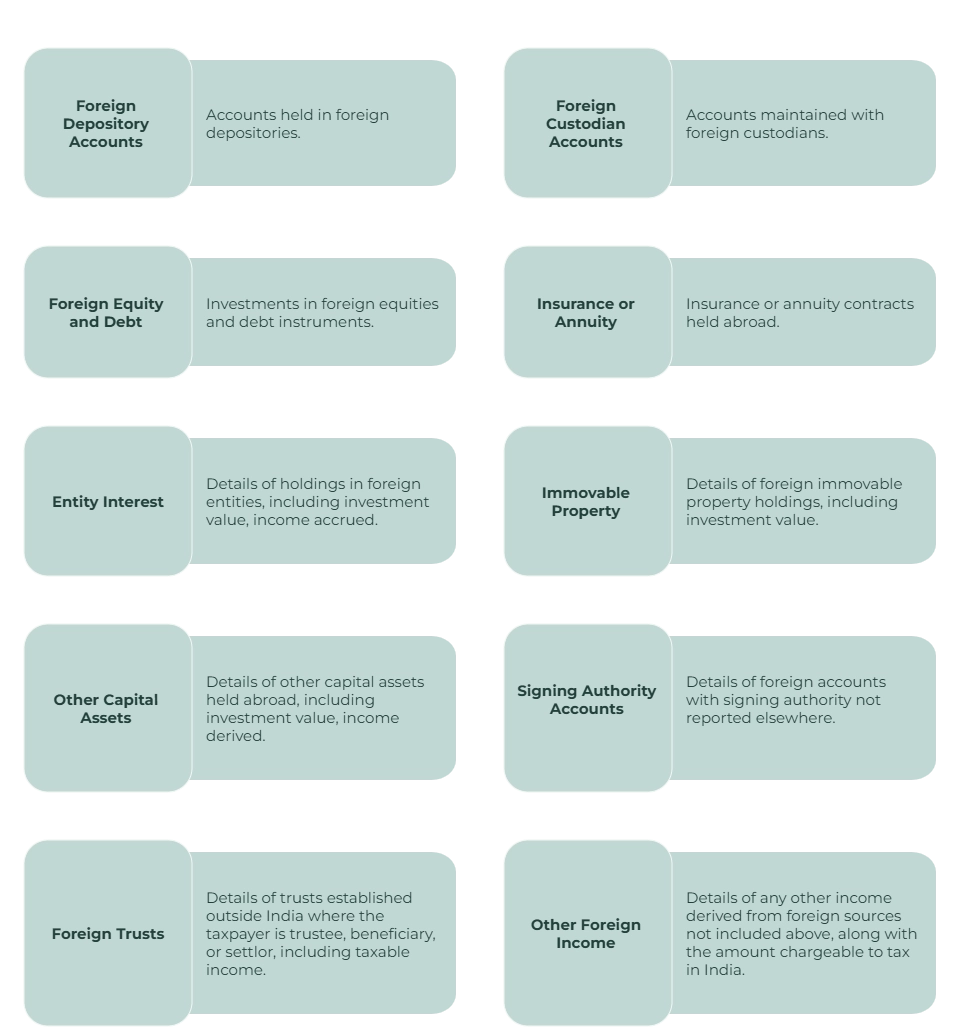
Schedule FA captures foreign assets and accounts held at any time during the relevant calendar year, whether you are the legal owner, beneficial owner or beneficiary.

The individual sections of Schedule FA are set out below:
 

Not sure where to begin?
Want the full picture? Read our comprehensive article on foreign asset and income reporting in India.

Read: Foreign asset and income reporting in India

A few related schedules and requirements should also be kept in mind:

  • Schedule AL is a separate statement of assets and liabilities and applies where total income exceeds ₹1 crore. It is not replaced by Schedule FA. Where Schedule AL applies, foreign assets may need to be reported in both schedules. Completing one does not remove the requirement to complete the other.
  • Schedule FSI reports foreign income country by country, along with the tax paid outside India and the foreign tax credit being claimed.
  • Form 67 must be filed separately to claim credit for taxes paid outside India, together with the prescribed supporting documents.

Foreign assets are reported through ITR-2 or ITR-3, both of which contain Schedules FA, FSI and TR. ITR-1 and ITR-4 do not contain these schedules and therefore cannot be used where foreign asset disclosure is required.

Three details that are easy to get wrong

Schedule FA follows the calendar year, not the financial year. For Assessment Year 2026–27, the relevant period ends on 31 December 2025, not 31 March 2026.

Foreign currency values must be converted using the SBI TTBR. Do not use a Google rate, the RBI reference rate or your bank’s quoted rate.

There is no minimum-value exemption. Dormant, low-balance, joint and inherited accounts, as well as assets that earned no income, must still be reviewed and reported where covered by Schedule FA, even if the taxpayer’s total income is below the taxable limit.

What happens if you get it wrong?

Failure to report a foreign asset, or reporting it inaccurately, can lead to proceedings under the Black Money (Undisclosed Foreign Income and Assets) and Imposition of Tax Act, 2015. The penalty can be as high as ₹10 lakh, apart from assessment proceedings and, in serious cases, prosecution.

These provisions are actively being enforced. A recent Income Tax Department campaign led 30,161 taxpayers to disclose ₹29,208 crore of foreign assets and ₹1,089 crore of foreign income. With information flowing in from foreign jurisdictions and the department using data analytics to compare it with tax returns, disclosure gaps are becoming easier to identify.

The new Foreign Assets Information report gives taxpayers a useful opportunity to review what has already been reported to the department before filing. It should, however, be treated as a cross-check rather than a complete record. Taxpayers who qualify as Resident and Ordinarily Resident should independently review their overseas accounts, investments and income, report them for the relevant calendar year using the prescribed exchange rates, and file the appropriate return. Where something has been missed, correcting it promptly is far better than waiting for the department to identify the mismatch.

We Are Waiting To Hear From You

Name *
Email *
What makes you a part of the global mobility world?
Company

We Are Waiting To Hear From You

Name*
Email ID*
What makes you a part of the global mobility world?
Nationality
Company
How can we help you?
Specific area(s)
Specific area(s)
Specific area(s)
Any specific details
Suggest time*
Suggest time 2*