
Whenever an Indian organisation considers bringing foreign talent on board, whether for technical expertise, senior management, or short-term assignments, a range of critical compliance requirements must be mapped out well before the expatriate’s arrival. Alongside immigration and tax compliance in India, the cost of social security contributions [Provident Fund (PF)] plays a pivotal role in both budgeting for the assignment and shaping the expat’s compensation expectations.
By law, both the employer and the expatriate employee are typically required to contribute 12% each of the employee’s full salary (with very few exceptions), amounting to a combined 24% towards India’s Provident Fund (PF) scheme. This substantial outlay can significantly increase the employer’s cost while also lowering the expatriate employee’s net take-home pay, making it a critical factor in compensation structuring and assignment budgeting for expatriates.
At the same time, many expatriates prefer to continue contributing to their home country social security schemes. Balancing these preferences with Indian compliance is often a complex process, as employers need to ensure compliance while also manage assignment costs effectively.
This article focuses to provide a practical guide on when PF contributions for expatriates are mandatory and when specific exemptions are available. Getting this right can ensure seamless onboarding, legal compliance, and optimal allocation of assignment costs.
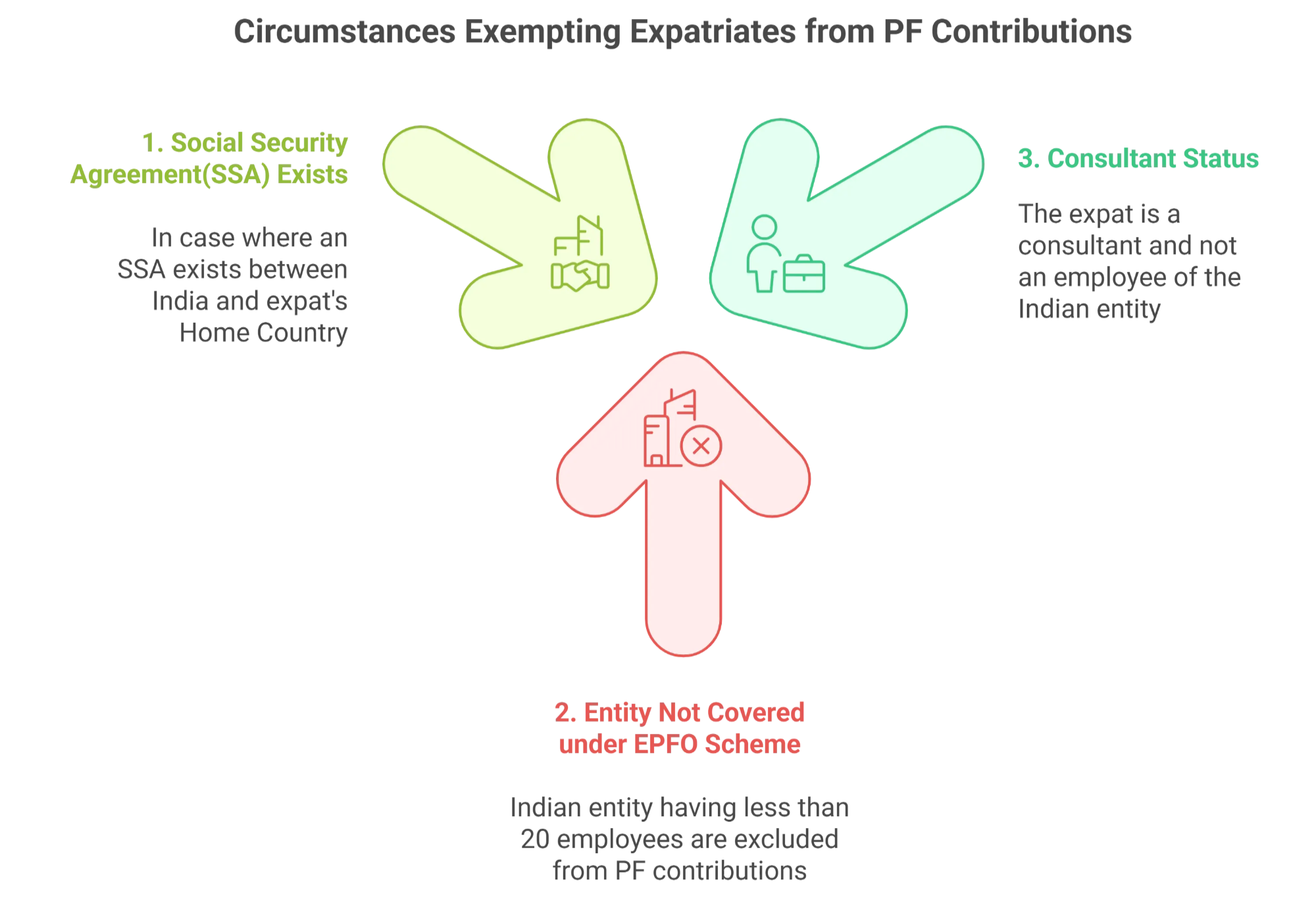
If an expatriate’s home country has a Social Security Agreement (SSA) with India, and the expatriate obtains a Certificate of Coverage (CoC) from their home country’s authorities, they are exempt from contributing to the Indian Provident Fund (PF). This exemption applies if the expatriate continues contributing to their home country’s social security scheme and submits the CoC as proof to the Indian employer and PF department. This typically occurs in secondment cases where the expatriate is transferred from a foreign parent or group company to its Indian affiliate. In such cases, the foreign entity remains responsible for social security contributions, and the expatriate is exempt from Indian PF upon submitting a valid CoC. Moreover, these expatriates are eligible to withdraw their PF balance immediately after completing their Indian assignment.
Provident Fund regulations apply only to establishments in India employing 20 or more individuals. Organisations with fewer than 20 employees are exempt from mandatory registration with the Employees’ Provident Fund Organisation (EPFO) and do not have to deduct or deposit PF contributions for any employee, including expatriates. This exemption generally covers small businesses, startups, new subsidiaries, and liaison offices that typically have limited headcount during their initial phases. While some smaller entities may choose voluntary registration and compliance, most do not, relieving expatriates working in such setups from mandatory PF deductions.
PF contributions are meant exclusively for ‘employees’ engaged under a formal employer-employee relationship, characterised by a regular salary and adherence to organisational supervision. Expatriates engaged as bona fide independent consultants, contracted on a service basis, remunerated via invoices or project fees, and lacking the typical employment benefits and controls are not subject to PF contribution requirements.
It is imperative to underscore that the distinction must be genuine; a consultancy arrangement cannot be a disguised employment contract to evade PF obligations; courts may look at substance over form if challenged.
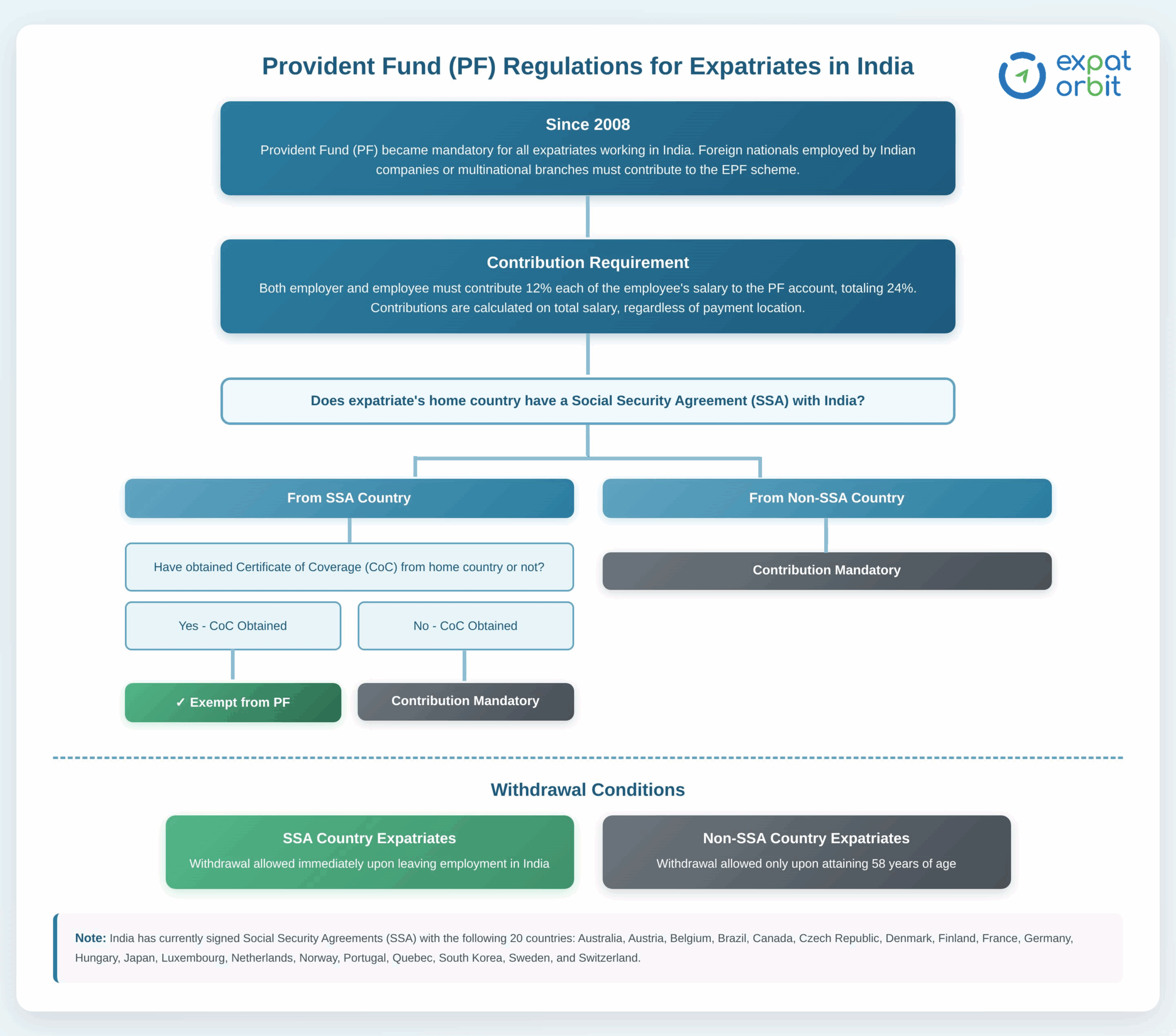
A deep insight into Provident Fund (PF) exemption rules is essential for employers to design cost-effective expatriate assignments while ensuring full compliance with Indian law. Nationals of SSA countries who do not obtain a Certificate of Coverage must contribute to PF but can withdraw their funds immediately after leaving India. In contrast, expatriates from non-SSA countries generally access their PF balances only after reaching 58 years of age, making these contributions effectively inaccessible for long periods.
Given the complexities of expatriate assignments and Provident Fund compliance, it is vital for employers to carefully evaluate assignment structures and compliance pathways to optimise costs and employee satisfaction.
Expat Orbit specialises in helping multinational organisations manage end-to-end expatriate assignments in India. Our expert team provides customised advisory on PF compliance, exemption eligibility, and documentation, along with comprehensive support on immigration, taxation, and local regulatory requirements. We work closely with your HR and finance teams to design assignment models that align with your business needs and keep your employees satisfied.
Beyond compliance, Expat Orbit offers hands-on assistance to simplify the entire assignment process. From filing PF contributions and managing withdrawals to ensuring smooth audits and interpreting Social Security Agreements, we deliver practical solutions that minimise risk and reduce administrative burden. For reliable, expert support, contact us at [email protected] or book a strategic consultation today.