

Form C is an online reporting mechanism through which hotels, guesthouses, hospitals, and similar establishments must share details of foreign nationals staying on their premises.
Purpose: Tracking foreign visitors, maintaining security, and updating immigration records.
Deadline: Filing must be completed within 24 hours of arrival (or 12 hours for certain nationalities).
Scope: Every guest requires an individual Form C — even in group bookings or for infants with passports.
Non-compliance is a direct violation of the Foreigners Act and attracts criminal penalties.
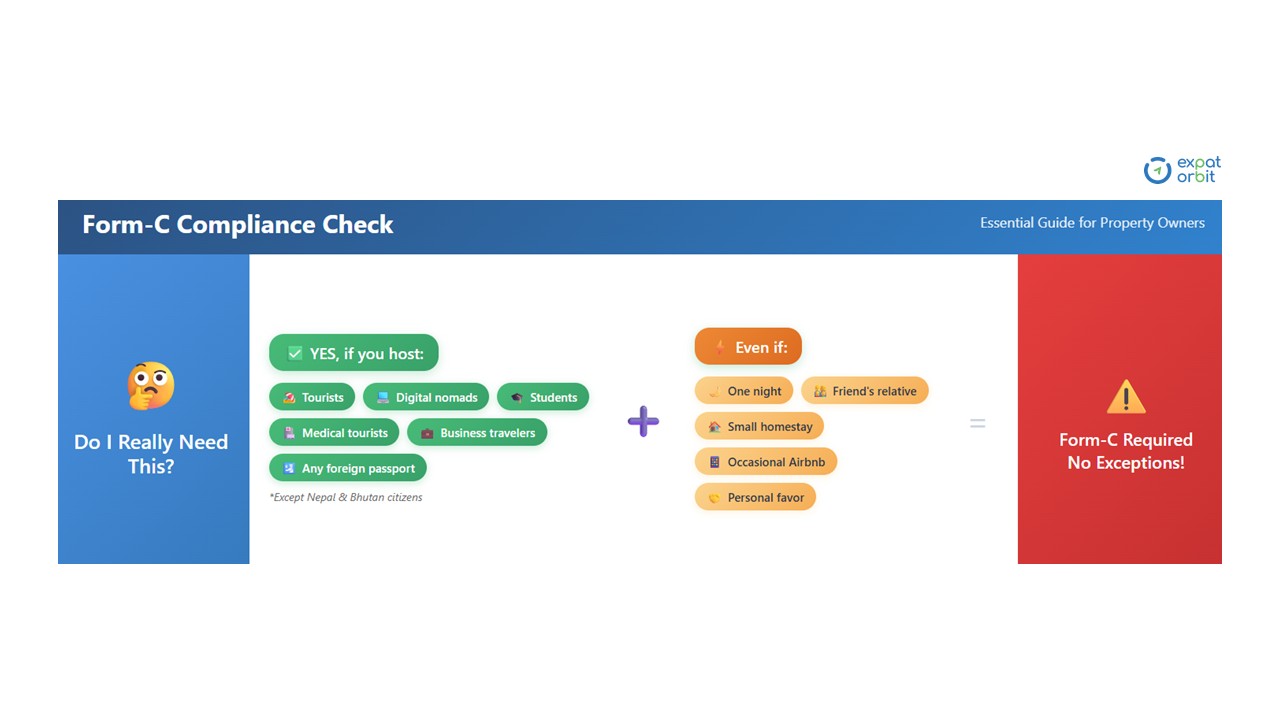
Obligated Entities:
Responsibility:
Exemptions:
At check-in or admission, verify and record:
| Guest's Country | File Within |
|---|---|
| Most countries | 24 hours of check-in |
| Pakistan, China, Afghanistan, Bangladesh, Iran | 12 hours of check-in |
| Nepal, Bhutan | No filing needed |
Check-out or Discharge Filing: Filing upon check-out or discharge is recommended to maintain complete records but is not uniformly mandatory.
Missing these deadlines is where most property owners get into legal trouble. The government doesn't accept "I forgot" or "I didn't know" as valid excuses.
Here's where many property owners make a dangerous assumption. They think Form-C is just bureaucratic red tape that nobody really enforces. That's a costly mistake. The penalties for non-compliance include:
This isn't theoretical. In 2013, hotel staff in Pune were actually arrested for failing to file Form-C for a foreign patient. Since then, there have been numerous cases across India where Airbnb hosts and small hotel owners have faced police action for non-compliance. Some properties have even been blacklisted by tourism authorities.
The scary part is that most property owners only discover these consequences after they've already broken the law. By then, it's too late to claim ignorance or promise to do better next time.
Common Challenges:
The Hidden Costs:
Many property owners don't realize how much time and stress this actually involves until they're deep into managing compliance themselves.
With the implementation of the Immigration and Foreigners Rules, 2025, notified by the Ministry of Home Affairs (MHA), the compliance requirements for Form C reporting in India have been expanded. Earlier, accommodation providers were responsible only for reporting the arrival and stay of foreign nationals. Now, the scope has been extended to include departure or checkout reporting as well, marking a significant regulatory enhancement in India’s immigration compliance framework.
This update underscores the government’s intent to create end‑to‑end tracking of foreign nationals through a centralised digital system managed by the Bureau of Immigration. By capturing accurate data from entry to exit, the new rules ensure that every visit is completely recorded. The move makes Form C compliance more comprehensive and technology-driven, helping authorities maintain an updated record of all foreign nationals staying in India.
What Has Changed Under the 2025 Rules?
Under the Immigration and Foreigners Rules, 2025, foreign nationals who are required to register in India must also ensure that their departure is reported to the concerned Registration Officer (FRRO/FRO) before they leave the country. The Rules are designed around a technology-enabled, online compliance system, using the Form C online portal and authorised digital platforms.
In practice, this means:
Hotels, guesthouses, serviced apartments, corporate housing providers, hospitals, educational institutions, and other entities hosting foreign nationals continue to play a central role in immigration compliance. While the primary obligation to report departure rests with the foreign national, hosts are expected to facilitate and support this process, particularly where Form C registration has been completed through their establishment.
Hosts should ensure that:
By doing so, hosts help ensure that immigration records remain current, complete, and compliant with the 2025 Rules.
Historically, Form C compliance focused largely on reporting the arrival and stay of foreign nationals. The 2025 Rules adopt a more comprehensive compliance approach by explicitly recognising the importance of departure reporting as an integral part of immigration monitoring.
For hosts and establishments, failure to ensure proper departure reporting may result in:
Timely and accurate departure reporting helps close the compliance loop, reducing legal exposure and demonstrating proactive adherence to evolving immigration regulations.
No More Technical Hassles
We take care of government portal navigation, system glitches, and downtime so your filings are never interrupted — even when official systems go offline.
Stay Fully Compliant
All filings are automatically submitted within required deadlines (24 hours in most countries, 12 hours in high-risk ones). Our team tracks regulation changes in real time and verifies every guest document to ensure accuracy.
Save Time and Costs
Skip the need for staff training on complex procedures. Check-ins move faster without compliance delays, and our dedicated support team is available whenever you need assistance.
Legal Peace of Mind
Every submission comes with a complete audit trail and instant confirmation receipts for your records. If authorities raise questions, our experts guide you through with confidence.
Form C compliance is a legal imperative for hotels and medical institutions alike. It safeguards your operations, assures regulatory adherence, and enhances the experience and safety of foreign guests and patients.
By knowing your obligations, training your teams, and leveraging technology, you can manage your compliance smoothly and avoid serious penalties.
At Expat Orbit, we work alongside property owners and institutions to simplify Form C filings, eliminate technical roadblocks, and provide audit-ready peace of mind. With our support, you can focus on running your business while staying fully compliant with immigration regulations.