
Africa is 54 countries. Each has its own employment laws, tax framework, immigration rules, and business culture. For Indian companies making a first move, the most active deployment markets tend to be:
The right market is the one your contract takes you to. But knowing its compliance profile before your team lands is what separates a smooth deployment from an expensive lesson.
For a first deployment without a local entity, companies typically reach for one of two options.
Engaging independent contractors or local distributor/vendor payrolls
This approach involves lower upfront cost and faster setup. Some Indian companies also place their employees on the payroll of a local distributor or vendor in Africa, relying on them to sponsor work permits and manage employment. However, where the substance of the working relationship remains with the Indian entity, African labour authorities will treat it as such, regardless of whose payroll the employee sits on. The consequences may include back taxes, statutory contribution liabilities, penalties, and ambiguity around employer obligations and work permit validity.
Employer of Record: The cleaner structure.
The EOR is the legal employer in the host country. Your employee works to your direction and delivers on your project. The EOR holds the employment contract, runs the locally compliant payroll, manages statutory contributions, and handles regulatory compliance.
You get the team on the ground. The compliance sits where it should.
This is where first deployments most commonly go wrong.
The work permit is a legal prerequisite, not a formality. Sending an employee without the correct authorisation, however short the visit is intended to be, creates immigration liability for both the employee and the company.
Before anyone travels:
Running your deployed employee through the Indian payroll is not sufficient. Most African countries require that income earned within their territory is taxed there, at source, through a locally registered payroll system.
Through an EOR, this is handled by design. The EOR runs local payroll, withholds applicable income tax, makes statutory contributions, and issues locally compliant payslips.
The employee's compensation is also reviewed against any applicable Double Taxation Avoidance Agreement to avoid dual contributions where treaty relief is available.
Compliance does not end at the work permit and payroll. The practical experience of the employee on the ground directly affects whether the assignment is completed successfully.
Africa presents specific settling-in challenges for Indian expatriates, including unfamiliar infrastructure, cultural differences, and in some locations, safety considerations. Organisations that overlook this aspect often face mid-assignment dropouts, which carry significant re-mobilisation costs.
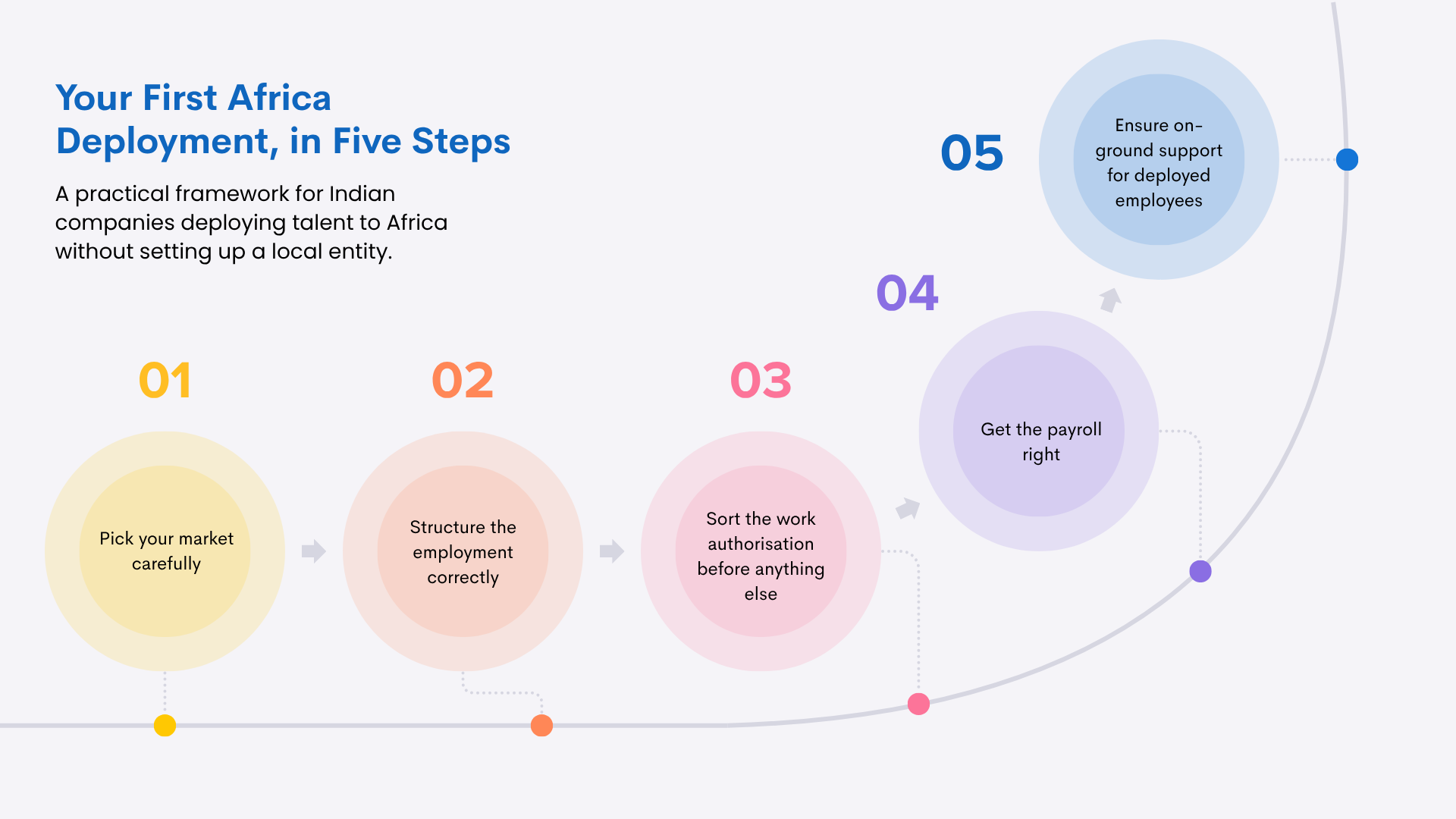
Key areas to address before and during the deployment:
A good EOR partner will facilitate this as part of the deployment scope, ensuring the employee is not just legally compliant but practically supported from the point of arrival
From contract signature to compliant boots on the ground:
A well-run EOR deployment takes weeks, not months. No entity. No incorporation costs. No compliance gaps.
Setting up your first team in Africa without a local entity can be more complex than it appears.
If not structured correctly, it can lead to compliance gaps across immigration, payroll, and tax. These issues do not just create financial exposure in the form of penalties and backdated liabilities, but can also impact your company's reputation in a new market.
For companies approaching their first deployment, the focus should be on getting the structure right from the outset.
If you want a clearer view of how most companies are managing this compliantly, our India-to-Africa EOR Guidebook breaks this down across key markets.