If you’re a Non-Resident Indian (NRI), Person of Indian Origin (PIO), or Overseas Citizen of India (OCI) living or working abroad, managing your finances between your resident country and India can feel complicated. Whether it’s sending funds home, saving, investing, or managing income earned in India, cross-border financial transactions often involve regulatory rules and compliance requirements.
To simplify this, the Reserve Bank of India (RBI) permits NRIs, PIOs, and OCIs to open special categories of bank accounts in India. These accounts comply with Foreign Exchange Management Act (FEMA) regulations and are specifically designed to help you legally and efficiently manage your Indian earnings, investments, and savings while staying compliant with Indian exchange control laws.
An NRI account is a bank account that NRIs, PIOs, and OCIs can open and maintain with Indian banks. These accounts allow you to hold and manage funds in Indian Rupees (INR) or foreign currency, depending on the type of account. They are essential for repatriating money, managing financial transactions, and handling investments in India in a seamless and compliant manner.

The NRE Account is the most widely used type of NRI bank account. It allows you to deposit your foreign income, which is then converted into INR at the prevailing exchange rate.
Maintained in Indian Rupees (INR)
Both principal and interest are fully repatriable
Can be opened as Savings, Current, Recurring Deposit, or Fixed Deposit
Interest earned is tax-free in India for non-residents
Ideal for managing overseas income and Indian expenses
Example:
If you work in the U.S. and remit funds to India for family expenses or savings, an NRE account is suitable.
An FCNR (B) account is ideal for NRIs who prefer to maintain their savings in foreign currency without converting them into Indian Rupees.
Deposits maintained in major global currencies like USD, GBP, EUR, AUD, etc.
Protects your savings from foreign exchange fluctuations
Principal and interest are fully repatriable
Interest earned is exempt from Indian income tax
Can be opened only as term deposits with maturity of up to five years
This account is a good choice if you want to safeguard your money against currency risks while planning to return to India in the future.
An NRO account is meant for NRIs who need to manage their income earned in India, such as rent, dividends, pension, or proceeds from property.
Maintained in Indian Rupees (INR)
Available as Savings, Current, Recurring, or Fixed Deposit
Accepts both Indian and foreign currency deposits
Funds can be repatriated up to USD 1 million per financial year, subject to applicable taxes
Interest earned is taxable in India
Can be held jointly with residents on a ‘former or survivor’ basis; can also be held jointly with NRIs or PIOs
Ideal for managing income generated from assets or investments in India.
An SNRR account is designed for non-residents who have business or commercial dealings with India. It functions like a non-interest-bearing current account.
You can use the SNRR account for transactions related to trade, investments, or project payments. Non-residents may also use this account to receive tax refunds or withdraw provident fund amounts. Any such funds must be repatriated abroad, as they cannot be used for local spending within India.
An escrow account is a secure bank account where funds are held by a neutral third party until specific conditions of a major regulated transaction are fulfilled. These accounts are used by NRIs, residents, and businesses for activities such as property purchases, share transfers, or merger and acquisition transactions.
Escrow accounts do not earn interest and are primarily used to ensure that funds are released only after all agreed terms are met.

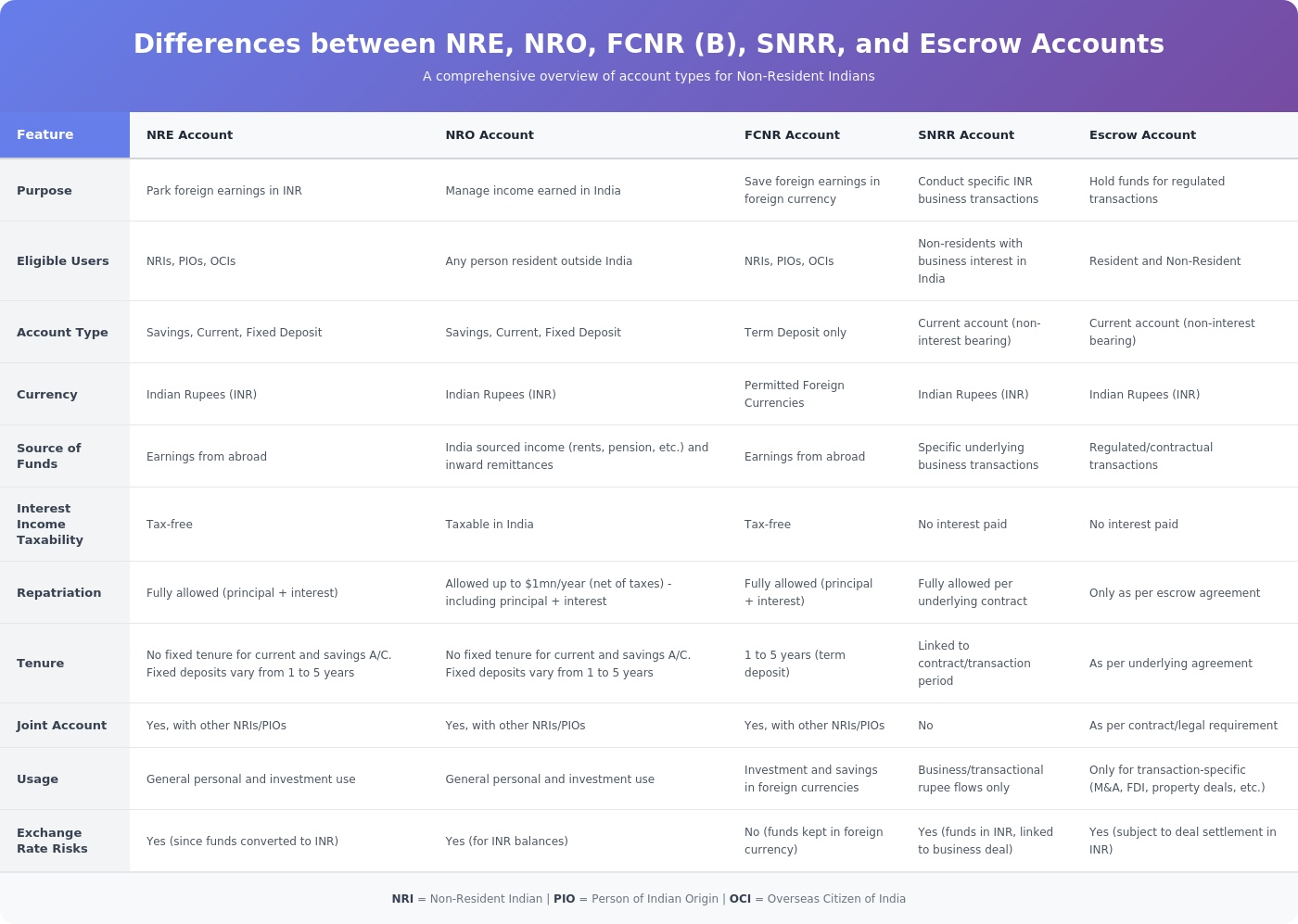
Differences between NRE, NRO, FCNR (B), SNRR, and Escrow Accounts
A comprehensive overview of account types for Non-Resident Indians
| Feature | NRE Account | NRO Account | FCNR Account | SNRR Account | Escrow Account |
|---|---|---|---|---|---|
| Purpose | Park foreign earnings in INR | Manage income earned in India | Save foreign earnings in foreign currency | Conduct specific INR business transactions | Hold funds for regulated transactions |
| Eligible Users | NRIs, PIOs, OCIs | Any person resident outside India | NRIs, PIOs, OCIs | Non-residents with business interest in India | Resident and Non-Resident |
| Account Type | Savings, Current, Fixed Deposit | Savings, Current, Fixed Deposit | Term Deposit only | Current account (non-interest bearing) | Current account (non-interest bearing) |
| Currency | Indian Rupees (INR) | Indian Rupees (INR) | Permitted Foreign Currencies | Indian Rupees (INR) | Indian Rupees (INR) |
| Source of Funds | Earnings from abroad | India sourced income (rents, pension, etc.) and inward remittances | Earnings from abroad | Specific underlying business transactions | Regulated/contractual transactions |
| Interest Income Taxability | Tax-free | Taxable in India | Tax-free | No interest paid | No interest paid |
| Repatriation | Fully allowed (principal + interest) | Allowed up to $1mn/year (net of taxes) - including principal + interest | Fully allowed (principal + interest) | Fully allowed per underlying contract | Only as per escrow agreement |
| Tenure | No fixed tenure for current and savings A/C. Fixed deposits vary from 1 to 5 years | No fixed tenure for current and savings A/C. Fixed deposits vary from 1 to 5 years | 1 to 5 years (term deposit) | Linked to contract/transaction period | As per underlying agreement |
| Joint Account | Yes, with other NRIs/PIOs | Yes, with other NRIs/PIOs | Yes, with other NRIs/PIOs | No | As per contract/legal requirement |
| Usage | General personal and investment use | General personal and investment use | Investment and savings in foreign currencies | Business/transactional rupee flows only | Only for transaction-specific (M&A, FDI, property deals, etc.) |
| Exchange Rate Risks | Yes (since funds converted to INR) | Yes (for INR balances) | No (funds kept in foreign currency) | Yes (funds in INR, linked to business deal) | Yes (subject to deal settlement in INR) |
Most Indian banks require the following documents:
Passport copy
Valid visa or residence permit
Overseas address proof
Recent passport-size photographs
PAN card or Form 60 (if PAN is not available)
Additional documents such as OCI/PIO card or FATCA declarations depending on the bank and jurisdiction
You can apply online or through overseas branches of major Indian banks like SBI, ICICI Bank, HDFC Bank, and others.

Understanding the features and differences between NRE, NRO, FCNR (B), SNRR, and Escrow accounts helps you choose the right option for your personal or business needs. Staying compliant with FEMA, RBI regulations, tax rules, and repatriation limits ensures smooth financial management and avoids legal issues.
For expert support on NRI taxation, FEMA compliance, or account opening, you can contact Expat Orbit. We assist NRIs, expatriates, and global companies in managing tax and regulatory requirements with clarity and confidence.