
Bilateral trade between India and Africa crossed USD 100 billion in 2024-25. The opportunities across infrastructure, energy, healthcare, and technology are well established. However, Africa comprises 54 countries, each with its own legal system, labour code, tax regime, and immigration framework. Regulatory requirements that apply in Kenya may not hold in Nigeria, and what is standard practice in South Africa may have no equivalent in Tanzania.
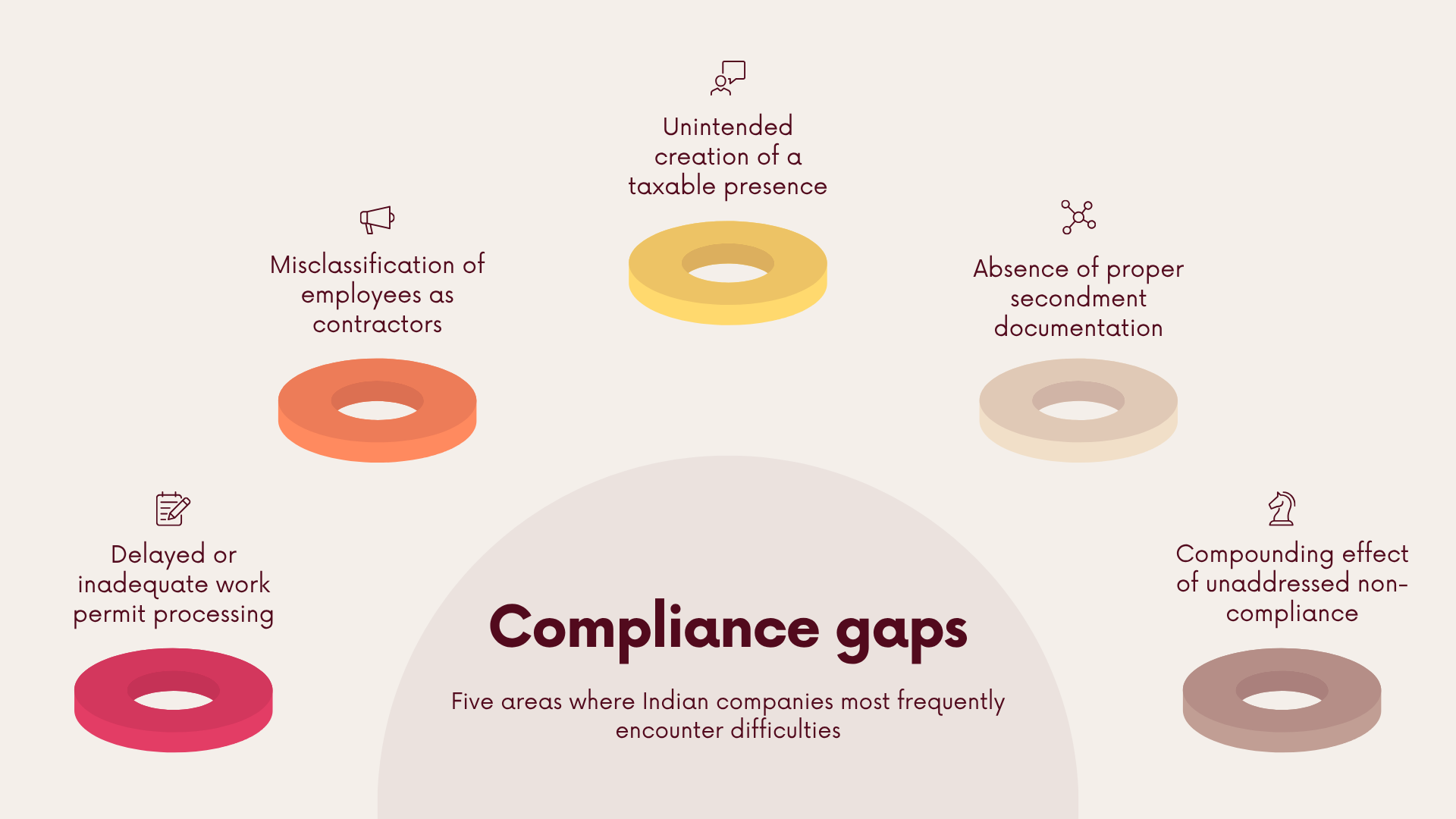
Compliance gaps in this environment tend to accumulate over time, often surfacing only when the consequences have already compounded. The following are five areas where Indian companies most frequently encounter difficulties.
Work permit timelines across Africa are longer than many Indian organisations anticipate, and each country follows a distinct process.

A Business Visa or e-Business Visa does not authorise employment or project execution in any of these jurisdictions. Where employees are deployed on such visas for operational work, the organisation is exposed to enforcement action, project disruption, and reputational consequences in markets where institutional trust takes time to establish.
It is advisable to initiate the work permit process at the point of contract finalisation, well before travel arrangements are made.
In some cases, organisations opt to engage personnel through contractor agreements rather than establishing a compliant employment structure in the host country. While this may appear to simplify the arrangement, African labour authorities assess the substance of the working relationship rather than the label on the contract.
Where an individual works exclusively for one organisation, follows its schedule, operates within its systems, and has no genuine financial independence, the relationship is likely to be classified as employment under local law, which may lead to legal consequences.
Labour codes across Africa are detailed and actively enforced. Relying on an Indian employment template without local legal review does not provide adequate protection.
Permanent Establishment (PE) is a tax concept under which the host country may tax the income of a foreign entity based on the activities its personnel perform in that jurisdiction. A registered entity or branch is not required for PE to be triggered.
The general principle is that the greater the degree of control the Indian entity retains over the deployed employee, the higher the PE risk. Where the employee continues to be supervised from India, evaluated by Indian managers, and compensated entirely through Indian payroll with no cost cross-charge to the host country, the tax authorities in the host jurisdiction may take the position that the Indian entity is effectively conducting business there.
Common triggers for PE exposure include:
Left unaddressed, these exposures can result in retroactive tax assessments, double taxation across both jurisdictions, and ongoing audit scrutiny. The structure of the employment arrangement is often the deciding factor in how tax authorities assess the situation, which is why it warrants careful review before deployment begins rather than after.
In many deployments, the visible compliance elements are in place: the employee holds a valid work permit and payroll is running locally. However, the structural documentation underlying the arrangement is missing.
Without a secondment agreement or inter-company agreement, there is no formal record defining who controls the employee, who bears the costs, and how the arrangement is structured from a legal and tax perspective.
Key documentation that is frequently overlooked includes:
In the absence of this documentation, the arrangement may appear compliant on the surface but remains structurally vulnerable if reviewed by tax authorities.
Establishing this documentation at the outset involves minimal cost and effort. Reconstructing it retrospectively in response to a regulatory query is considerably more burdensome.
Compliance gaps in Africa tend to compound over time, which is what makes them particularly costly.
Beyond the financial implications, the consequences extend to: